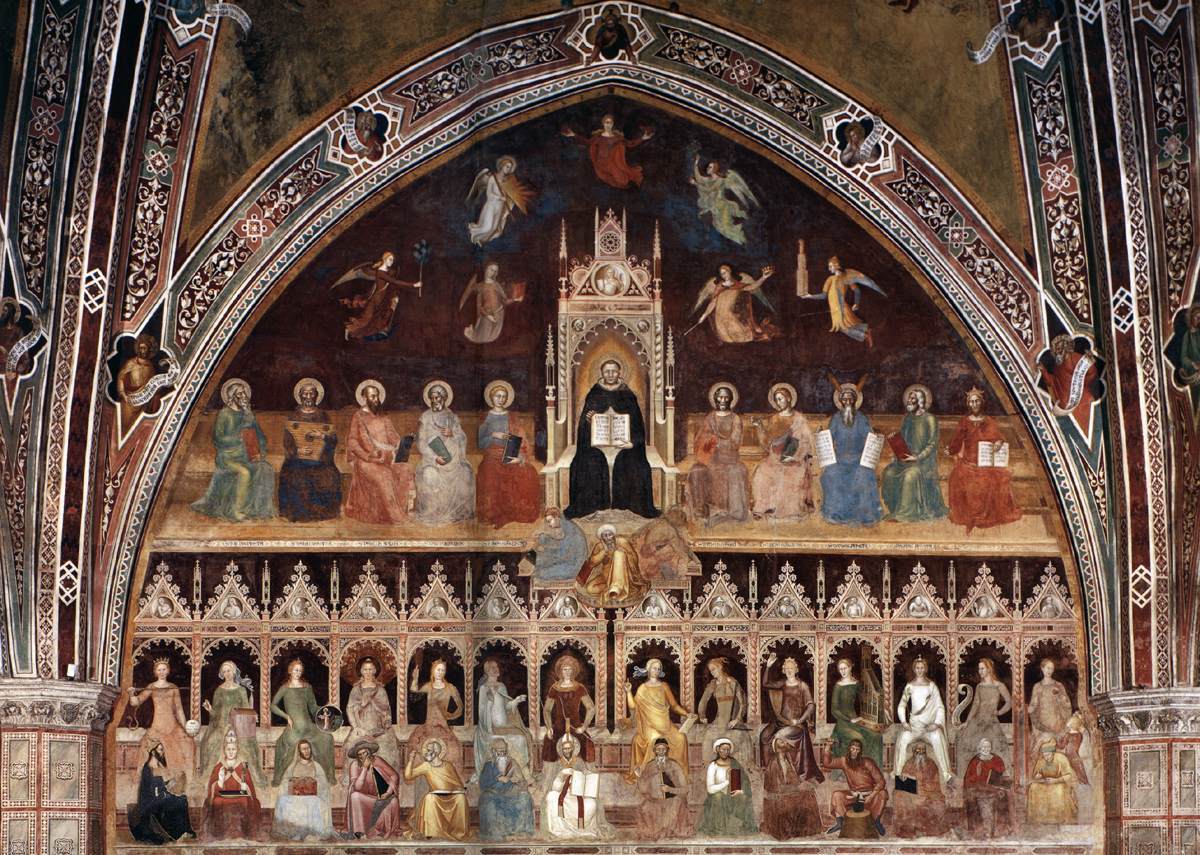
Florence, Italy, is widely celebrated as the birthplace of the Renaissance. For many first-time visitors, the main destination is the Galleria dell'Accademia to see Michelangelo's iconic David. Yet just a pleasant 15-minute stroll away lies a hidden gem: the Cappellone degli Spagnoli (Spanish Chapel), a Dominican chapel now part of the Santa Maria Novella Museum complex.
Though modest and unassuming from the outside, the chapel reveals its true splendor once you step inside. Inside you are met with such beauty it overwhelms the soul. Your eyes take in the altar and the Passion of Christ fresco directly leading into the space, but if you turn to the left you will find the captivating scene known as The Triumph of St. Thomas Aquinas (also known as Triumph of St. Thomas Aquinas and the Allegory of the Sciences), painted by Andrea di Bonaiuto (Andrea da Firenze) around 1366.
I could write an entire essay on this painting alone—and many have—but today we will focus on the bottom half of the fresco.
On the left side, seven women personify the seven sacred sciences, each accompanied by a key patron figure as envisioned by the artist: Civil Law with Emperor Justinian, Canonical Law with Pope Clement V, Philosophy with Aristotle, Holy Scripture with St. Jerome, Theology with St. John of Damascus, Contemplation with Dionysius the Areopagite, and Preaching with St. Augustine of Hippo.
On the right side, another seven women personify the seven liberal arts, each with their respective patrons: Arithmetic with Pythagoras, Geometry with Euclid, Astronomy with Ptolemy, Music with Tubal-Cain, Dialectic (or Logic) with Pietro Ispana (Peter of Spain), Rhetoric with Cicero, and Grammar with Priscian.
With this image in mind, I would like to dedicate this essay to exploring the trivium and quadrivium so beautifully depicted by Andrea di Bonaiuto in Florence more than six hundred years ago. For many families who did not grow up with a classical education, these terms may be unfamiliar. With that in mind, discussing these ideas—and why they have been held in such high regard for thousands of years—is an excellent step toward understanding what it means to be classically educated and why it matters.
The Trivium and Quadrivium form the foundational pillars of classical education, a time-tested approach that develops the whole person through rigorous intellectual training. Originating in ancient Greece and formalized during the Middle Ages, these seven liberal arts were designed to liberate the mind from ignorance and equip individuals for lives of virtue, wisdom, and effective citizenship. The Trivium focuses on the arts of language and thought, while the Quadrivium addresses the arts of quantity and harmony in the natural world. Together, they create a comprehensive curriculum that prioritizes deep understanding over mere information recall, fostering critical thinkers rather than passive consumers of knowledge.
The Trivium, meaning three ways or three roads in Latin, consists of grammar, logic, and rhetoric. These subjects form the initial stage of learning, teaching students how to engage with language and ideas effectively. Grammar involves not only the mechanics of language but also the foundational knowledge of any subject—what words and structures mean in context. Logic (often called dialectic) trains the mind in reasoning, argumentation, and the identification of fallacies. Rhetoric elevates communication to an art, enabling persuasive and eloquent expression. Mastery of the Trivium builds a strong linguistic and analytical foundation before advancing to more abstract studies.
Grammar, in this context, is the art of ordering and understanding symbols—whether in language, mathematics, or science. It cultivates precision and clarity. Logic sharpens the intellect through deductive and inductive reasoning, helping learners distinguish truth from falsehood. Rhetoric, the capstone of the Trivium, integrates the prior two arts by focusing on invention, arrangement, style, memory, and delivery. This progression mirrors natural human development: absorbing facts (grammar), questioning and analyzing them (logic), and articulating insights persuasively (rhetoric). As the 12th-century theologian and educator Hugh of St. Victor wrote:
"Grammar is the knowledge of how to speak without error; dialectic is clear-sighted argument which separates the true from the false; rhetoric is the discipline of persuading to every suitable thing."
Hugh of St. Victor
The importance of the Trivium lies in its emphasis on intellectual discipline and moral formation. In an age of information overload and sound bites, these skills counteract superficial thinking by training individuals to read deeply, reason soundly, and communicate with integrity. Students educated in the Trivium become independent learners capable of self-education long after formal schooling ends. It promotes humility before truth, as logic demands submission to evidence, and rhetoric encourages ethical persuasion rather than manipulation. This foundation nurtures virtuous citizens who can contribute thoughtfully to society.
The Quadrivium, meaning four ways, builds upon the Trivium by exploring the mathematical and scientific realities of the universe. It comprises arithmetic, geometry, music, and astronomy. These disciplines reveal the underlying order and harmony of creation, progressing from pure number to its applications in space, sound, and celestial motion. In classical education, the Quadrivium follows the Trivium because a mind trained in language and logic is better prepared to grasp quantitative truths without being overwhelmed by abstraction.
Arithmetic deals with the theory of numbers themselves—their properties, relationships, and operations—beyond mere calculation. Geometry examines shapes, spatial relations, and proofs, revealing beauty and proportion in the physical world. Music, understood broadly as harmony and rhythm, studies the mathematical ratios in sound and their effects on the soul. Astronomy investigates the motions of heavenly bodies, connecting earthly observation to cosmic order. Each subject demonstrates how mathematics permeates reality, encouraging wonder at the universe's intelligible design.
Studying the Quadrivium develops a profound appreciation for order, beauty, and causality. It counters modern tendencies toward narrow specialization by revealing interconnections between disciplines—for instance, how geometric principles underpin architectural beauty or musical composition. These arts elevate the mind from the particular to the universal, preparing students for philosophy and theology. They instill intellectual virtues such as patience in proof, precision in measurement, and awe at natural laws—qualities essential for scientific inquiry and ethical decision-making in technology-driven societies.
The integration of the Trivium and Quadrivium creates a holistic educational framework that addresses both the qualitative and quantitative dimensions of human experience. The language arts enable clear thinking and expression, while the mathematical arts ground that thinking in objective reality. This balanced approach avoids the pitfalls of purely literary education (which can become subjective) or purely technical training (which can lack wisdom). Classical education views these seven arts as preparatory for higher pursuits, such as philosophy—the love of wisdom—and ultimately, a life oriented toward truth, goodness, and beauty.
This integrated curriculum endured as the core of Western education until the Renaissance, when it gradually gave way to new humanistic approaches. In today's context, the Trivium and Quadrivium remain vital because they cultivate timeless skills amid rapid technological change. Classical education produces resilient minds that can adapt, innovate, and lead with moral clarity. It also counters cultural fragmentation by reconnecting learners to the Western intellectual tradition, fostering continuity and purpose.
Reviving emphasis on the Trivium and Quadrivium promises a renaissance of thoughtful, well-rounded individuals. By prioritizing mastery of fundamentals over standardized testing or fleeting trends, classical education equips generations to navigate complexity with wisdom. Its enduring relevance underscores a profound truth: true education liberates the soul, sharpens the intellect, and prepares one not just for a career, but for a meaningful life in pursuit of the highest goods.
Now return to the fresco in your mind. Above the fourteen ladies and their patrons sits a row of biblical characters from both the Old and New Testaments, along with three defeated heretics at the feet of St. Thomas Aquinas. Looking higher still, one sees the three theological virtues and the four cardinal virtues depicted as angelic beings, and above them all, a depiction of Christ (not pictured). The artist, Andrea di Bonaiuto, ordered his love for the world to bear witness to divine truth. The Trivium and Quadrivium are keys to a quality education, but all wisdom and knowledge remain empty unless directed toward the greater purpose of serving and honoring the Lord. The apostle Paul reminds us in 1 Corinthians 13:1–2:
"Though I speak with the tongues of men and of angels, and have not charity, I am become as sounding brass, or a tinkling cymbal. And though I have the gift of prophecy, and understand all mysteries, and all knowledge; and though I have all faith, so that I could remove mountains, and have not charity, I am nothing."
1 Corinthians 13:1–2
Let us be the generation that heeds the wisdom of the past by dedicating ourselves and our families to studying the Trivium and Quadrivium—not for our own glory, but for the glory and honor we can bring to the Lord—ordering our loves rightly, just as we see depicted on the wall of that quiet chapel painted so long ago.