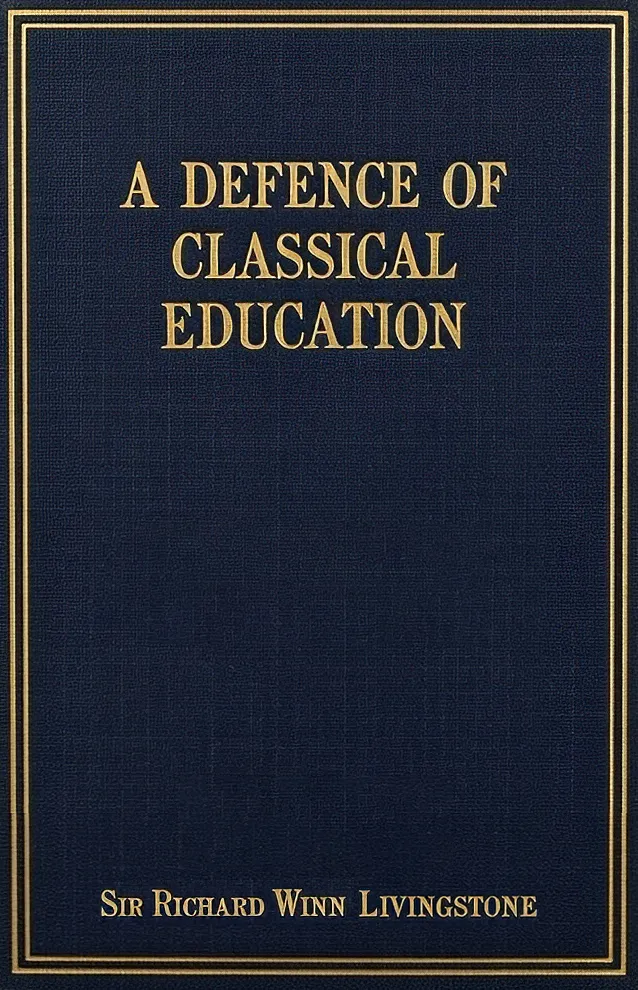
A Defence of Classical Education
In A Defence of Classical Education, Sir Richard Livingstone, a British classical scholar and educational reformer, passionately argues for the enduring value of studying Latin, Greek, and the literature, history, and philosophy of ancient Greece and Rome amid early 20th-century criticisms favoring more "practical" or scientific curricula. Written during World War I, the book counters the notion that classical education is outdated or irrelevant by demonstrating its compatibility with scientific achievement (noting Germany's success despite strong classical traditions) and addressing the deeper cultural and intellectual weaknesses in British education. Livingstone contends that the humanities, particularly the classics, provide essential insights into human nature, foster flexibility of mind, imagination, and wisdom, and offer a profound understanding of our civilizational origins that modern subjects alone cannot replicate.
Livingstone systematically builds his case: Greek literature and thought represent the pinnacle of creative intelligence, supplying timeless ideas in ethics, politics, and aesthetics, while Roman history and character emphasize duty, resilience, and practical statesmanship. He defends the rigorous study of grammar and prose composition for cultivating precision, concentration, and linguistic mastery, and advocates reforms to make classical education more accessible and focused on "Realien" (real knowledge of the ancient world) rather than narrow scholarship. Ultimately, Livingstone views classical education as vital for forming responsible, thoughtful citizens capable of independent judgment, warning that neglecting it risks cultural shallowness and a loss of the standards by which societies evaluate themselves. The work remains a compelling testament to the classics' role in developing the whole person.
- Paideia Introduction2:32
- Author's Preface0:20
- Introduction26:10
- Physical Science and the Humanities50:48
- The Case for the Classics: Greek1:41:49
- The Case for Latin45:40
- Some Educational Advantages of the Classics1:20:53
- The Case for Grammar and Prose Composition43:31
- Reforms1:00:12
Chapter-by-chapter navigation, listening progress, and bookmarks are available in the member library.
Audiobook · 1883
Home Education
Home Education is a foundational work of educational philosophy and practical guidance, originally delivered as lectures to parents and…
Audiobook · 1897
Parents and Children
Charlotte Mason's Parents and Children , Volume 2 of her Home Education series, serves as a profound sequel to Home Education , shifting…
Audiobook · 1901
Insect Life
Insect Life , the sixth and final volume in Arabella Buckley's beloved Eyes and No Eyes series, concludes the children's exploration of the…