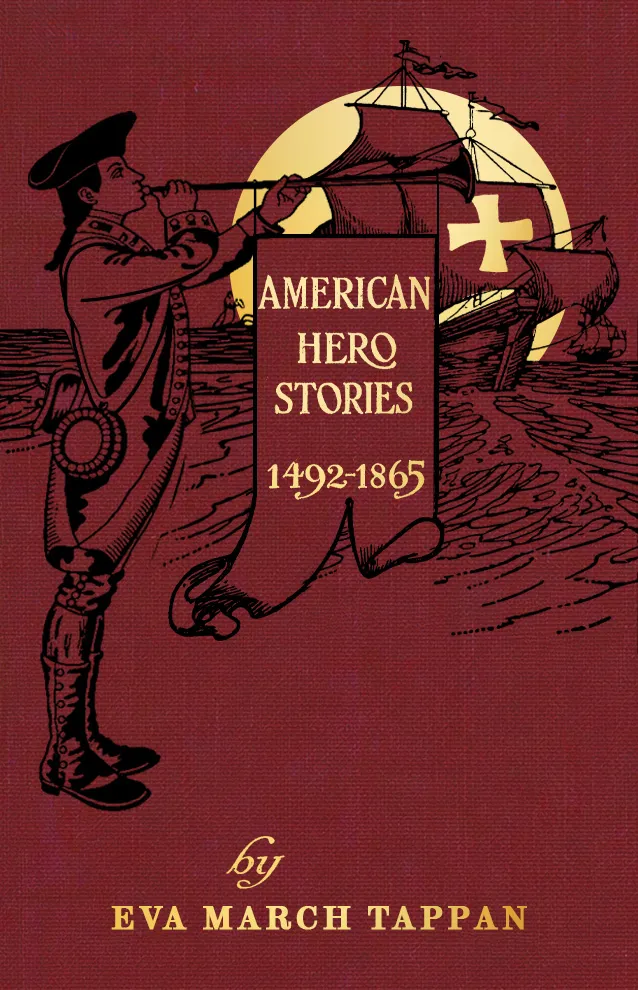
American Hero Stories by Eva March Tappan is a concise, engaging narrative for young readers that traces key figures and dramatic episodes in early American history, from the Age of Exploration through the Civil War era. Written in Tappan's characteristic accessible, storybook style, it brings to life the explorers, settlers, soldiers, pioneers, and leaders who shaped the nation through vivid personal tales of courage, perseverance, and adventure.
The book covers key heroes such as Christopher Columbus, Ferdinand Magellan, Francis Drake, John Smith, Samuel de Champlain, Miles Standish, Peter Stuyvesant, King Philip, William Penn, George Washington (as a young soldier), Israel Putnam, "Mad" Anthony Wayne, George Rogers Clark, John Paul Jones, Daniel Boone, Meriwether Lewis and William Clark, Oliver Hazard Perry, Dolly Madison, David Crockett, Kit Carson, and Abraham Lincoln. Tappan highlights dramatic moments—such as Washington’s daring Christmas crossing of the Delaware, the endurance at Valley Forge, Perry’s bold capture of the British fleet, and the stirring events that inspired the Star-Spangled Banner—while weaving together vivid stories of early settlements, Revolutionary struggles, westward expansion, and the growth of national identity.
- Paideia Introduction2:48
- Preface1:31
- Christopher Columbus, who first crossed the Atlantic Ocean15:41
- Ferdinand Magellan, who found the way around the world15:06
- Francis Drake, Seaman of Queen Elizabeth17:58
- John Smith, the Father of Virginia14:13
- Samuel de Champlain, the Founder of Quebec13:10
- Miles Standish, Commander-in-Chief of the Pilgrims17:40
- Peter Stuyvesant, Last Dutch Governor of New York13:13
- King Philip, Chief of the Wampanoags14:17
- The Men Who Explored the Mississippi15:11
- William Penn, Who Founded Pennsylvania11:40
- George Washington, the Young Soldier10:20
- James Wolfe, who captured Quebec12:15
- When Pontiac Besieged Detroit9:51
- The First Day of the Revolution7:47
- Israel Putnam, Soldier of the Revolution7:58
- A Christmas Surprise7:22
- A Winter at Valley Forge8:02
- How “Mad Anthony” Took Stony Point7:19
- How the “Swamp Fox” Made the British Miserable6:34
- George Rogers Clark, who gave three states to the Union9:12
- John Paul Jones, and his sea fights for America8:13
- Daniel Boone, the Kentucky Pioneer9:20
- Meriwether Lewis and William Clark, Who showed the way to the Pacific12:07
- Oliver Hazard Perry, Who captured a British fleet7:33
- Dolly Madison, Who guarded the nation’s treasures7:37
- The Star-Spangled Banner7:02
- David Crockett, the Tennessee Pioneer10:57
- Christopher Carson, trapper and guide10:52
- Abraham Lincoln, pioneer and President12:42
- U S Grant, the boy who did not wish to be a soldier15:57
- Robert Lee, the soldier who loved peace18:01
- Theodore Roosevelt, American citizen18:58
- The First World Flight16:24
Chapter-by-chapter navigation, listening progress, and bookmarks are available in the member library.
Audiobook · 1918
The Little Book of the Flag
The Little Book of the Flag is a concise, engaging narrative for young readers that traces the history and symbolism of the American flag…
Audiobook · 1901
Insect Life
Insect Life , the sixth and final volume in Arabella Buckley's beloved Eyes and No Eyes series, concludes the children's exploration of the…
Audiobook · 1883
Home Education
Home Education is a foundational work of educational philosophy and practical guidance, originally delivered as lectures to parents and…