
History of Alexander the Great
History of Alexander the Great is a vivid, narrative biography in the author's immensely popular Makers of History series, written in a clear, engaging storybook style that serves as an ideal bridge for older children through young adult readers. Abbott crafted the volume with thoughtful attention to the intellectual and moral needs of youth aged roughly 15 to 25 (and adaptable for motivated younger students), transforming complex historical events into accessible, character-driven tales that spark curiosity, encourage moral reflection, and foster a love for truth rather than mere facts.
Drawing from classical sources, it portrays Alexander III of Macedon (356–323 BC) as a brilliant, ambitious conqueror whose short but extraordinary life transformed the ancient world, blending historical events with insights into his character shaped by his tutor Aristotle and his father King Philip II.
The book recounts Alexander's early exploits, his swift consolidation of power after Philip's assassination, the crossing of the Hellespont, major victories over the Persians including the defeats of Darius at Issus and Gaugamela, the sieges of Tyre and Gaza, his campaign in Egypt (founding Alexandria), and his relentless march into India. Abbott explores Alexander's military genius, leadership, vision of cultural fusion, and the personal toll of ambition, including the gradual deterioration of his character amid triumphs, culminating in his early death at age 32 in Babylon.

- Paideia Introduction2:04
- Author's Preface1:48
- His Childhood and Youth26:04
- Beginning of His Reign25:08
- The Reaction25:12
- Crossing the Hellespont27:15
- Campaign in Asia Minor27:23
- Defeat of Darius23:42
- The Siege of Tyre23:55
- Alexander in Egypt25:07
- The Great Victory27:09
- The Death of Darius26:07
- Deterioration of Character21:07
- Alexander's End34:03
Chapter-by-chapter navigation and listening progress are available in the member library.
Made to go with History of Alexander the Great
To print at home or open on your computer. Included with membership.
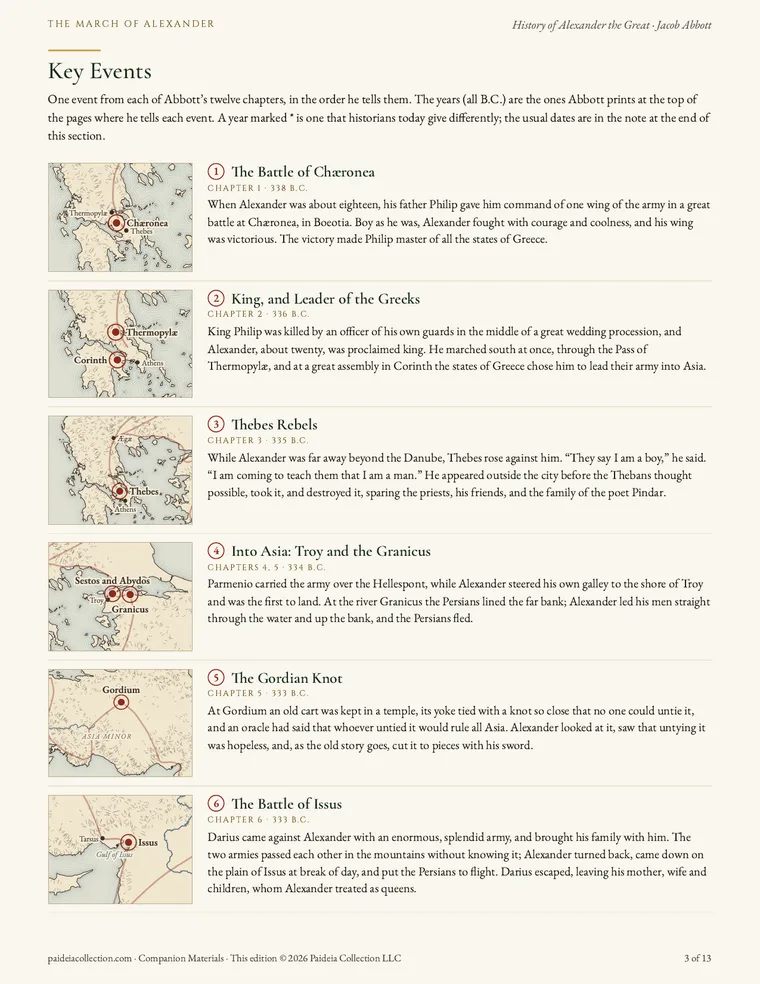
- Key events
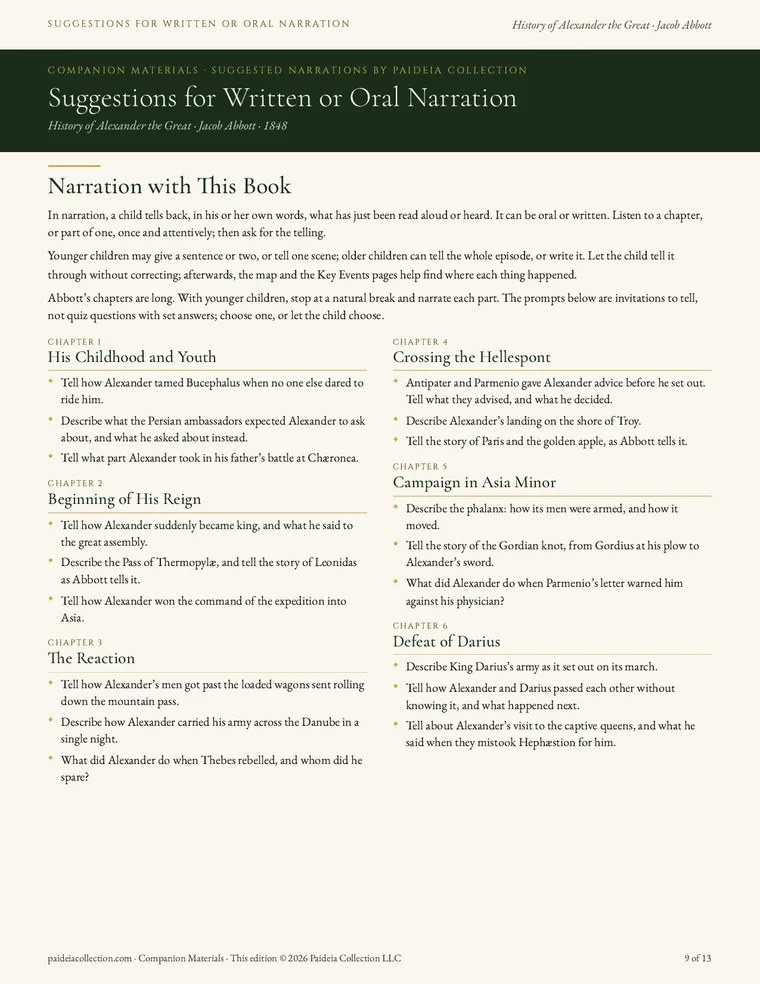
- Narration prompts
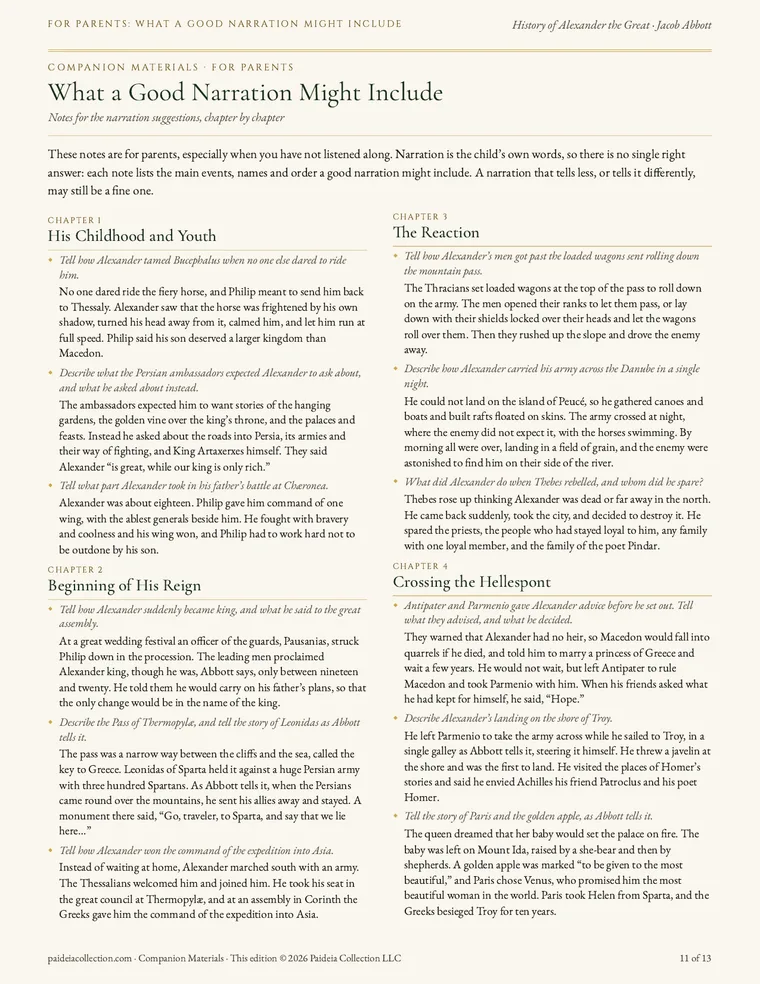
- For parents
Companion Volume
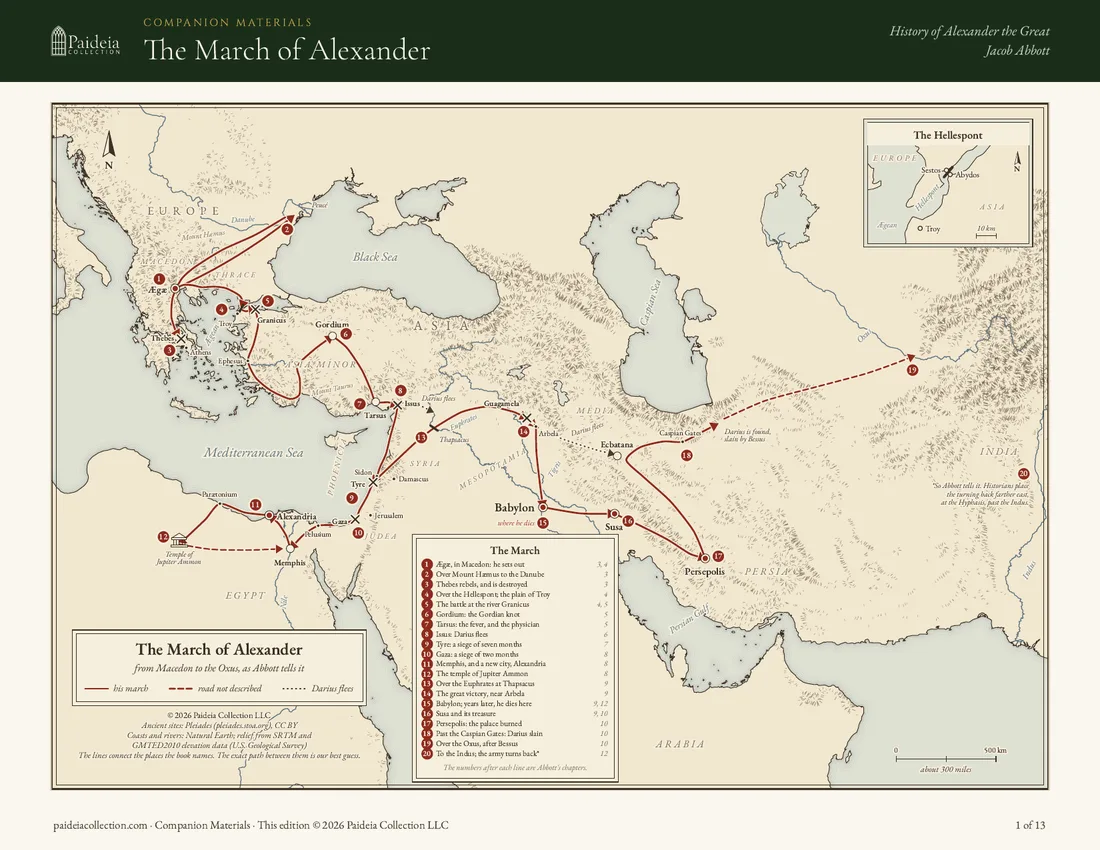
The March of Alexander
Everything for the book, bound together: the maps, the people, the names and the narration work.
- Color
- Print-friendly
What’s inside
- The march on one map, every place numbered in the order Abbott tells it
- Key events, each with its own small map
- Who's Who: the people of the story
- The kings of Persia, on one family chart
- How to say the names, with the Makers of History timeline
- Narration prompts, chapter by chapter
- For parents: what a good narration might include
- Where these people turn up again in other books
Companion materials come with membership, along with the entire collection.All the companion materials
Next in the Series
History of Genghis Khan
Jacob Abbott’s History of Genghis Khan, first published 1860 as part of his Makers of History series, traces the life of Temujin, the…
Audiobook · 1850
History of Cyrus the Great
History of Cyrus the Great by Jacob Abbott is a engaging, narrative biography in the author's popular Makers of History series, written in…
Audiobook · 1901
Insect Life
Insect Life, the sixth and final volume in Arabella Buckley's beloved Eyes and No Eyes series, concludes the children's exploration of the…