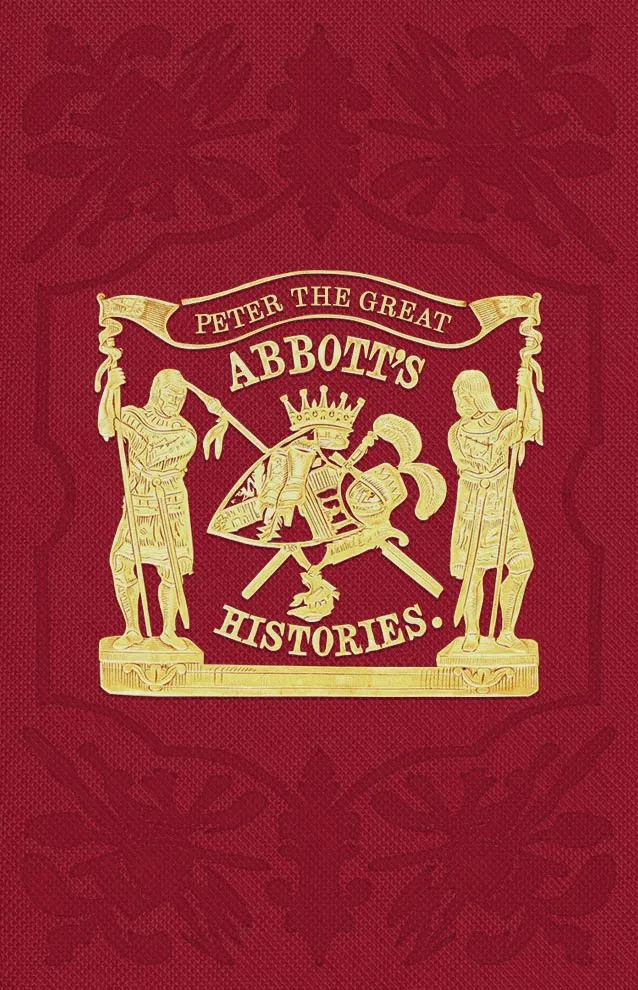
Cover of History of Peter the Great by Jacob Abbott Coming Soon
Makers of History Series

History of Peter the Great

1859
Published
This title is in production and will be available to all active subscribers the day it is released.
Coming Soon Browse the Library

Jacob Abbott’s History of Peter the Great, published 1859 as part of the Makers of History series) recounts the rise and reign of Peter I of Russia. It begins with the succession struggles after the death of Tsar Alexis, in which the ambitious half-sister Sophia seeks power amid the frailty of Peter’s half-brothers, before young Peter is proclaimed co-ruler and eventually consolidates sole authority. Abbott describes Peter’s energetic youth, his early interest in practical skills and Western ideas, key advisers such as Le Fort and Menshikov, the capture of Azov, and the famous Grand Embassy tour of Europe, during which Peter studied shipbuilding and other crafts in Holland and England.

The narrative then covers the Streltsy rebellion on Peter’s return, which he suppresses harshly, followed by sweeping reforms to modernize the army, government, and society. It details the Great Northern War against Sweden, including the defeat at Narva, the founding of St. Petersburg, Mazeppa’s revolt, and the decisive victory at Poltava over Charles XII. Later chapters treat Peter’s relationship with his second wife Catherine, the tragic conflict with his son Alexis (who flees, is brought back, tried, and dies in custody), and the continued expansion and internal changes that continue until Peter’s death in 1725. Written in clear, accessible prose for younger readers, the book presents Peter as an energetic, often ruthless modernizer who transformed a vast and traditionally isolated empire.

Portrait of Jacob Abbott

Jacob Abbott was born on November 14, 1803, in Hallowell, Maine. He was the second of seven children and the eldest of five brothers, all of whom pursued education at Hallowell Academy and later graduated from Bowdoin College. To distinguish himself from his father and grandfather (both named Jacob Abbot), he added an extra "t" to his surname during his college years. After graduating from Bowdoin in 1820, Abbott continued his studies at Andover Theological Seminary, where he prepared for a career in ministry while also beginning to teach, including a stint at Portland Academy where one of his students was the young Henry Wadsworth Longfellow. Abbott's professional life blended education, ministry, and writing. He served as a professor of mathematics and natural philosophy at Amherst College from 1825 to 1829, was licensed to preach in 1826, and founded the Mount Vernon School for Young Ladies in Boston in 1829, serving as its principal until 1833. He later became pastor of the Eliot Congregational Church in Roxbury, Massachusetts, which he helped establish. In collaboration with his brothers, he founded Abbott's Institute in New York City and other educational ventures, including schools for boys and girls, reflecting his lifelong commitment to progressive education for young people. Abbott became one of the most prolific American authors of the 19th century, penning over 180 books and contributing to or editing dozens more. He is best remembered for his children's literature, particularly the popular Rollo series, which followed the adventures of a curious boy learning moral and practical lessons through everyday experiences. He also produced the Franconia Stories and the influential Makers of History series, consisting of 22 biographical volumes on figures like Alexander the Great, Julius Caesar, and Peter the Great. These works combined engaging narratives with historical facts, making complex subjects accessible to young readers and earning praise even from figures like Abraham Lincoln. In his later years, Abbott spent considerable time in Farmington, Maine, where his brother Samuel Phillips Abbott founded the Abbott School. He continued writing religious books, popular science, and general reader works alongside his juvenile fiction and biographies. Jacob Abbott passed away on October 31, 1879, in Farmington at the age of 75, leaving a lasting legacy as a pioneering educator and author who shaped generations of children's literature and moral instruction in America.