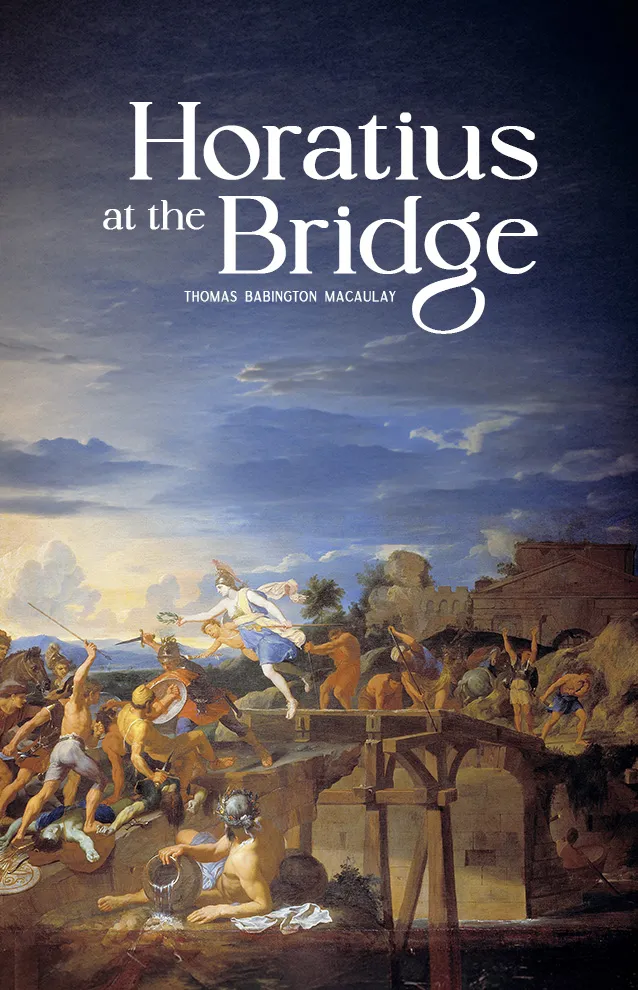
Cover of Horatius at the Bridge by Thomas Babington Macaulay

Horatius at the Bridge

24m
Duration

“Horatius at the Bridge,” the most celebrated poem in Thomas Babington Macaulay’s Lays of Ancient Rome (1842), is a stirring narrative ballad that retells a legendary episode from early Roman history. Drawing primarily from Livy and other ancient sources, Macaulay recounts how Publius Horatius Cocles, together with two companions, Spurius Lartius and Titus Herminius, single-handedly defends the Pons Sublicius—the wooden bridge spanning the Tiber River—against the invading Etruscan army led by Lars Porsena of Clusium. As the Roman forces retreat and prepare to destroy the bridge to save the city, Horatius stands firm, urging his comrades to hold the narrow pass until the structure collapses behind them. The poem culminates in Horatius’s heroic leap into the Tiber, swimming to safety amid the cheers of Rome. Macaulay presents the tale not as dry history but as a vivid, rhythmic lay meant to echo the lost ballad tradition of ancient Rome itself.
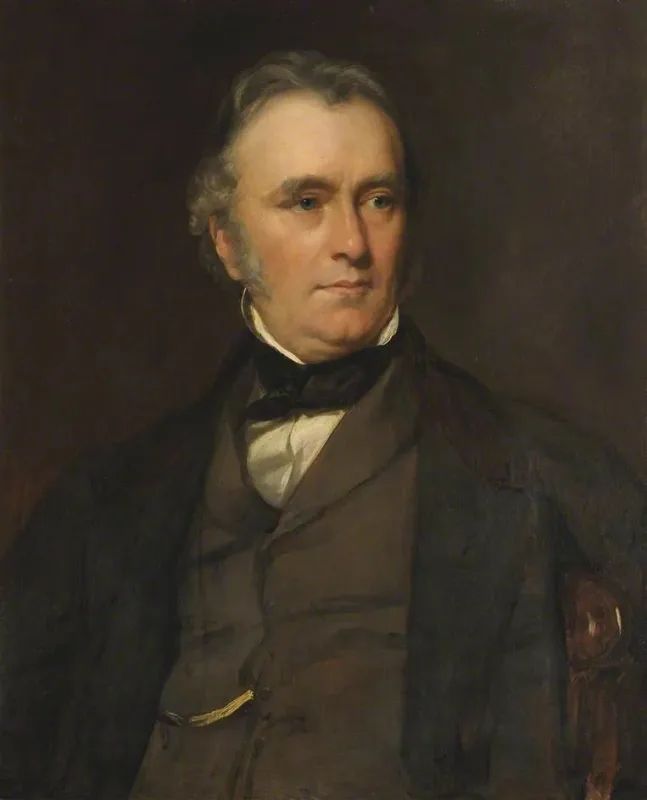
Portrait of Thomas Babington Macaulay

Thomas Babington Macaulay was born on October 25, 1800, in Rothley Temple, Leicestershire, England, into a prominent evangelical family. His father, Zachary Macaulay, was a leading abolitionist and former governor of Sierra Leone. From an early age, Macaulay displayed extraordinary intellectual gifts, reading voraciously and demonstrating a remarkable memory. He was educated at Trinity College, Cambridge, where he excelled in classics and won several prestigious prizes. After briefly studying law and being called to the bar in 1826, he turned toward literature and politics. His career as a writer began in earnest with contributions to the Edinburgh Review, where his lively, opinionated essays on literature, history, and politics quickly established him as one of the leading literary voices of his generation.

Macaulay’s public life combined literature with active political service. Elected as a Whig Member of Parliament in 1830, he supported the Reform Act of 1832 and advocated for the abolition of slavery. In 1834, he accepted a position on the Supreme Council of India, where he made his most controversial contribution: the famous “Macaulay Minute” of 1835. In it, he argued forcefully for the promotion of English-language education in India, aiming to create a class of Indians who would be “Indian in blood and colour, but English in taste, in opinions, in morals, and in intellect.” He returned to Britain in 1838 and later served as Secretary at War and Paymaster-General. His political career reflected the optimistic liberalism of the Victorian era, emphasizing progress, education, and constitutional reform.

As a writer, Macaulay achieved lasting fame through both poetry and prose. His Lays of Ancient Rome (1842), a collection of stirring narrative poems, became enormously popular and remained a staple of Victorian education. However, his greatest achievement was The History of England from the Accession of James the Second, published in five volumes between 1848 and 1861. Written in a vivid, dramatic style that combined sweeping narrative with sharp character portraits, the work celebrated the development of British liberty, parliamentary government, and Protestant values. Though often criticized for its Whig bias and occasional historical simplifications, Macaulay’s History was a phenomenal commercial success and helped define how generations of readers understood the Glorious Revolution and the emergence of modern Britain.

Macaulay was elevated to the peerage as Baron Macaulay in 1857 but suffered declining health in his final years. He died on December 28, 1859, at age 59 and was buried in Westminster Abbey. His legacy remains complex: he is remembered as one of the supreme masters of English prose style, whose clarity and rhetorical power influenced countless later writers. At the same time, his views on empire and culture have drawn criticism in the postcolonial era. Nevertheless, Macaulay stands as a quintessential figure of nineteenth-century British intellectual life, embodying both the confidence and the contradictions of the Victorian age.

  1. Paideia Introduction1:34
  2. Horatius at the Bridge22:26
  3. Paideia Closing0:36

Chapter-by-chapter navigation, listening progress, and bookmarks are available in the member library.