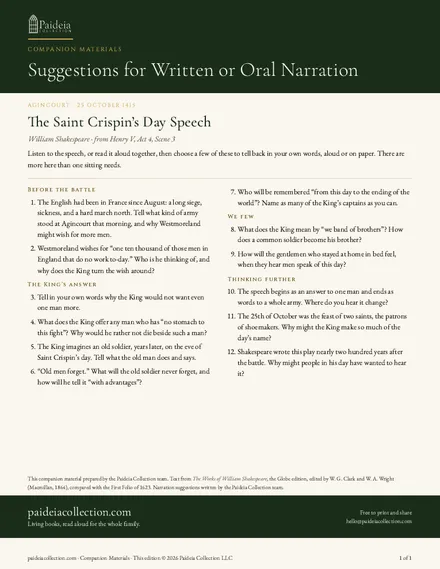
Narration Guide
Questions to talk over after each chapter, for written or oral narration.
- Color
- Print-friendly
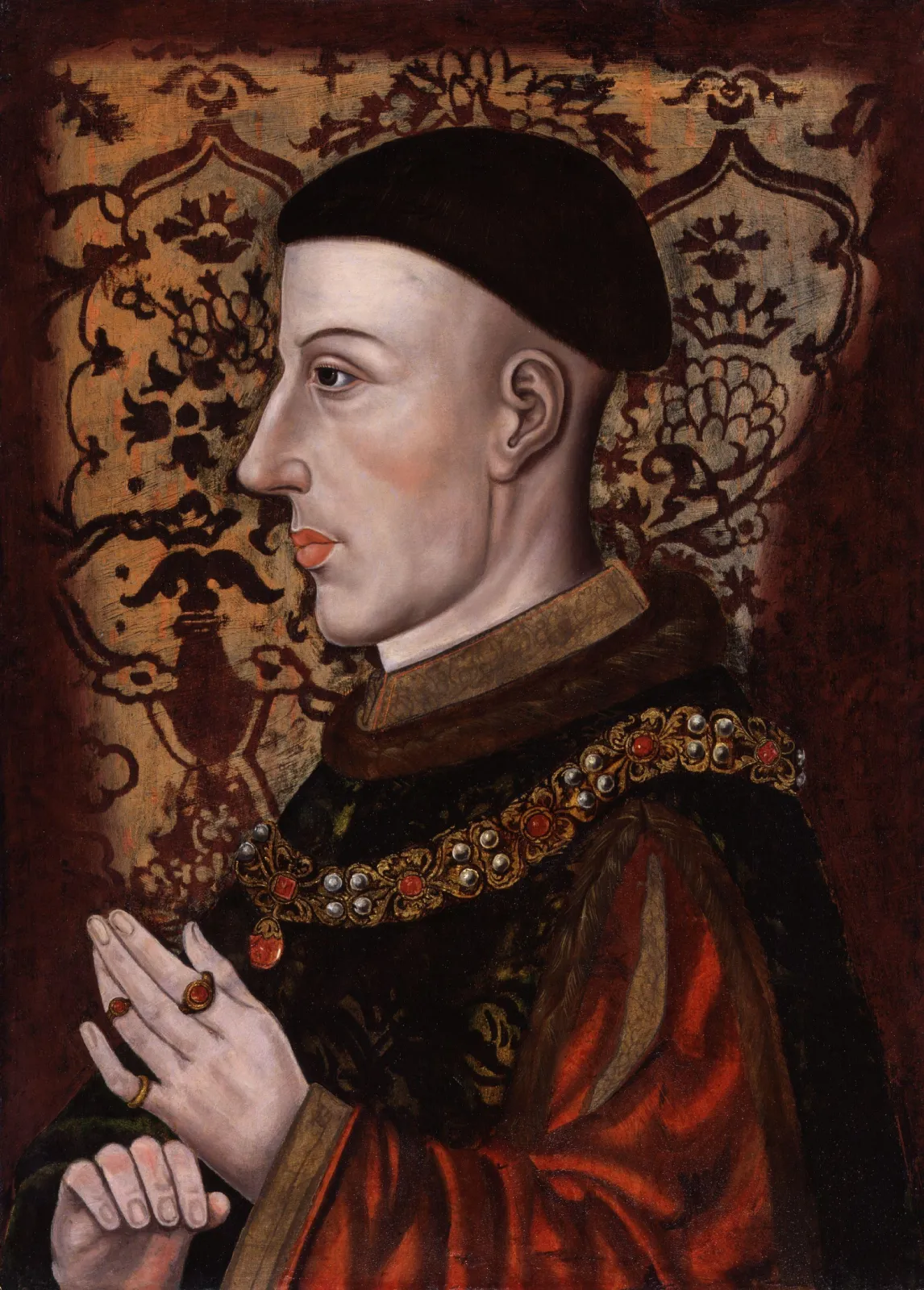
On the morning of the Battle of Agincourt, King Henry V addresses his badly outnumbered English army after a nobleman wishes aloud for more troops from home. Henry rejects the idea, arguing that the fewer men present, the greater each soldier’s share of honor; he would rather not share the coming glory with anyone who was not there to earn it. He then turns the date itself into a rallying cry, declaring that this St. Crispin’s Day will be remembered forever, and that every man who fights will be able to show his scars and boast of his deeds on the anniversary for the rest of his life.
He promises that those who shed blood with him will become his “band of brothers,” elevated to the status of noblemen regardless of their birth, while gentlemen who stayed safely in England will think themselves accursed and hold their manhood cheap when the stories of the battle are told. The speech ends by picturing the survivors as living legends whose names will be as familiar in England as household words, and by urging the army to prepare for the fight so that the day may be theirs.
Chapter-by-chapter navigation and listening progress are available in the member library.
To print at home or open on your computer. Included with membership.
Questions to talk over after each chapter, for written or oral narration.
Texts to Keep
The speech, set to follow along as you listen.
Texts to Keep
The speech, set for learning by heart.
Companion materials come with membership, along with the entire collection.All the companion materials
Audiobook · 1863
Gettysburg Address
Abraham Lincoln delivered the Gettysburg Address on November 19, 1863, at the dedication of the Soldiers’ National Cemetery in Gettysburg,…
Audiobook · 1901
Insect Life
Insect Life, the sixth and final volume in Arabella Buckley's beloved Eyes and No Eyes series, concludes the children's exploration of the…
Audiobook · 1910
Calvert of Maryland: A Story of Lord Baltimore's Colony
Calvert of Maryland: A Story of Lord Baltimore's Colony is a children's historical fiction narrated by young George Calvert (a fictional…