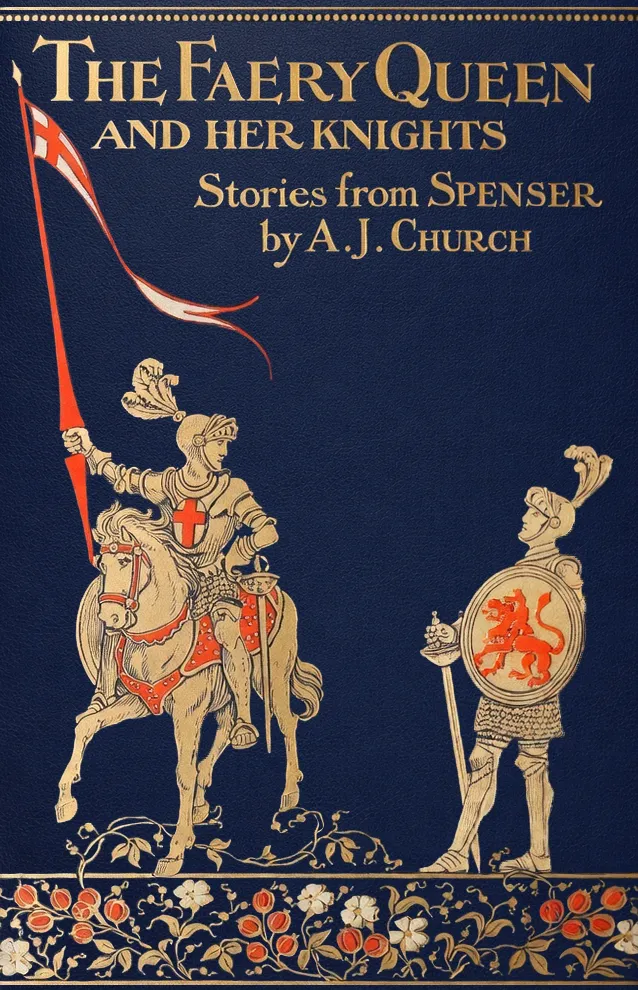
The Faery Queen and Her Knights
The Faery Queen and Her Knights (also published as The Faery Queen for Boys and Girls), written by Alfred J. Church, is a prose retelling of selected adventures from Edmund Spenser’s epic poem The Faerie Queene, specially adapted for young readers. Church simplifies the original’s complex allegory, archaic language, and dense symbolism into clear, engaging narrative stories while preserving the spirit of chivalric quests, bravery, and moral testing. Set in the mythical land of Faerie, the tales follow noble knights who serve Queen Gloriana (the Faery Queen) as they confront dragons, giants, sorcerers, false knights, and enchantresses. The book opens with the Red-Cross Knight (representing holiness) and the pure Lady Una as they set out to slay a great dragon that has devastated her parents’ kingdom, only to face deception by the wizard Archimago and the false Duessa, captivity by the giant Orgoglio, and eventual rescue by Prince Arthur before the final battle and betrothal.
The remaining chapters continue with other knights and their parallel adventures drawn from Spenser’s first six books. Sir Guyon embodies temperance as he resists the seductive dangers of the Bower of Bliss and the enchantress Acrasia; the female knight Britomart pursues her destined love Artegall after seeing his image in Merlin’s magic mirror, while also rescuing captives such as Amoret; and further episodes feature Artegall’s quest for justice, the friendship tales of Cambell and Triamond, the wanderings of Florimell, and Sir Calidore’s pursuit of the Blatant Beast amid pastoral scenes and courtesy. Throughout, Church emphasizes courage, loyalty, and the triumph of good over deception and excess, presenting the stories as lively, self-contained adventures full of knights, ladies, magic, and monsters that introduce young readers to the wonders of Spenser’s world without the original poem’s full length or difficulty.

- Paideia Introduction2:08
- The Red-Cross Knight9:23
- Archimage and Duessa14:58
- The Fortunes of Una11:29
- Of What Befell at the House of Pride6:52
- How the Red-Cross Knight Leaves the Castle of Pride9:27
- The Lady Una and the Satyrs10:41
- Of the Giant Orgoglio11:26
- Of the Deeds of Prince Arthur9:58
- Of the House of Holiness14:24
- Of the Slaying of the Dragon10:24
- Of Sir Guyon and the Lady Medina9:44
- How Sir Guyon Came into Great Peril18:12
- Of Two Pagan Knights10:36
- Of Queen Acrasia9:11
- Britomart10:07
- Of Merlin's Magic Mirror12:22
- How Britomart Took to Arms14:52
- Sir Scudamore and Amoret12:45
- Of Sir Paridell and Others10:08
- The Story of Canacé and the Three Brothers16:47
- The Story of Florimell10:37
- Of the False Florimell11:45
- Sir Satyrane's Tournament11:34
- Of Florimell's Girdle5:49
- Of Britomart and Artegall15:31
- Of the Fortunes of Amoret10:32
- Of Sir Artegall and the Knight Sanglier7:31
- Of Other Adventures of Sir Artegall18:24
- Sir Artegall Does Justice10:47
- Radigund19:02
- How Sir Artegall Was Delivered21:39
- Of the Knave Malengin6:56
- Of the Lady Belgé16:29
- Of Sir Artegall and Grantorto10:42
- Of Sir Calidore and the Lady Briana12:03
- Of the Valour of Tristram13:02
- Sir Calepine and the Lady Serena11:32
- Of Sir Calidore and Pastorella10:11
- The End of Sir Calidore's Quest14:15
Chapter-by-chapter navigation and listening progress are available in the member library.
Audiobook
Parables from Nature
Parables from Nature (often referred to as Parables of Nature), by the British writer Margaret Gatty, is a collection of short allegorical…
Audiobook · 1901
Insect Life
Insect Life, the sixth and final volume in Arabella Buckley's beloved Eyes and No Eyes series, concludes the children's exploration of the…
Audiobook · 1910
Calvert of Maryland: A Story of Lord Baltimore's Colony
Calvert of Maryland: A Story of Lord Baltimore's Colony is a children's historical fiction narrated by young George Calvert (a fictional…