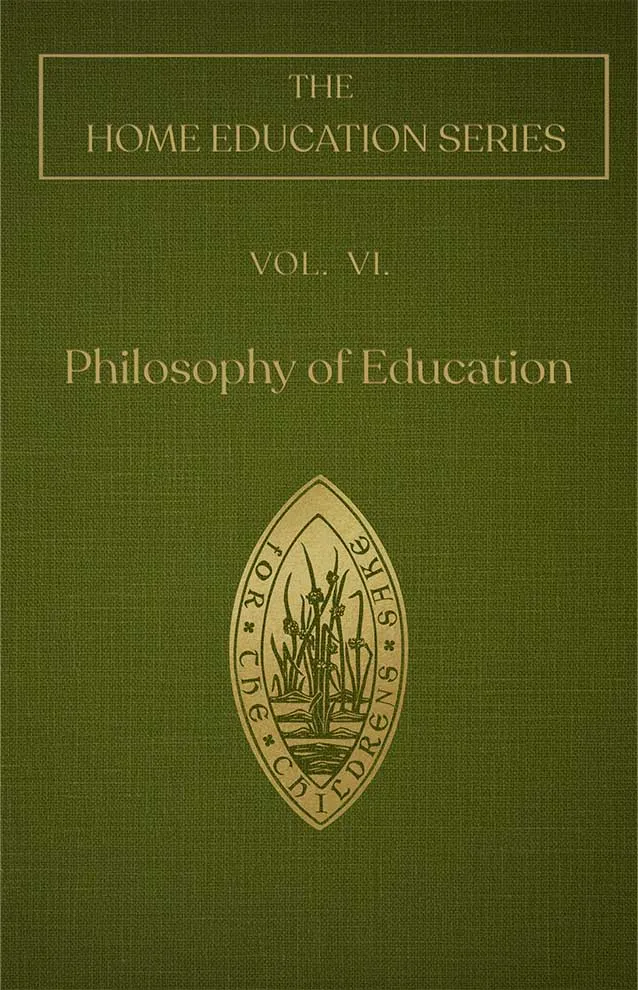
A Philosophy of Education
Charlotte Mason's A Philosophy of Education (Volume 6 of her Home Education Series), subtitled An Essay Towards a Philosophy of Education: A Liberal Education for All, represents the culmination and most comprehensive articulation of her educational thought, written near the end of her life in 1923 and published posthumously in 1925. Drawing on decades of practical experience through the Parents' National Educational Union (P.N.E.U.), Mason synthesizes her philosophy into a coherent system grounded in the foundational principle that children are born persons—possessing innate reason, spiritual capacity, and the ability to form vital personal relations with knowledge from birth. She rejects prevailing educational paradigms that treat children as blank slates, vessels to be filled, or mere products of environment and heredity, instead insisting that the mind is alive and hungers for ideas just as the body hungers for food. Education, therefore, is "the science of relations," where children naturally establish connections with knowledge across a broad, generous curriculum when presented properly—through living books, narration, short focused lessons, nature study, habit training, and exposure to art, music, poetry, history, science, mathematics, and Scripture—fostering self-education rather than teacher-imposed instruction. The volume opens with a synopsis of her 20 principles (later expanded from earlier formulations), explores self-education as the child's responsibility through effort and attention, and defends a liberal education accessible to all social classes, not reserved for the elite. As the capstone to her series, this work unifies the practical guidance of prior volumes into a profound philosophy that continues to inspire modern educators and homeschoolers seeking education that respects and awakens the whole person. To many, this is actually the best volume to read first for those just being introduced to Charlotte Mason.
- Paideia Introduction2:13
- Foreword and Preface8:40
- A Short Synopsis8:18
- Introduction41:06
- Book I, Ch. 1 — Self-Education20:26
- Book I, Ch. 2 — Children Are Born Persons28:31
- Book I, Ch. 3 — The Good and Evil Nature of a Child46:22
- Book I, Ch. 4 — Authority and Docility25:43
- Book I, Ch. 5 — The Sacredness of Personality29:14
- Book I, Ch. 6 — Three Instruments of Education39:04
- Book I, Ch. 7 — How We Make Use of Mind37:39
- Book I, Ch. 8 — The Way of the Will22:33
- Book I, Ch. 9 — The Way of the Reason31:32
- Book I, Ch. 10 — The Curriculum2:18:42
- Book II, Ch. 1 — A Liberal Education in Elementary Schools31:24
- Book II, Ch. 2 — A Liberal Education in Secondary Schools1:02:46
- Book II, Ch. 3 — The Scope of Continuation Schools45:27
- Book II, Ch. 4 — The Basis of National Strength1:33:27
- Supplementary - Too Wide a Mesh12:53
- Paideia Closing0:36
Chapter-by-chapter navigation, listening progress, and bookmarks are available in the member library.
Next in the Series
Home Education
Home Education is a foundational work of educational philosophy and practical guidance, originally delivered as lectures to parents and…
Audiobook · 1897
Parents and Children
Charlotte Mason's Parents and Children , Volume 2 of her Home Education series, serves as a profound sequel to Home Education , shifting…
From Our Essays
Charlotte Mason — A Gentle, Timeless Philosophy
An introduction to Charlotte Mason — the life and ideas behind this book.