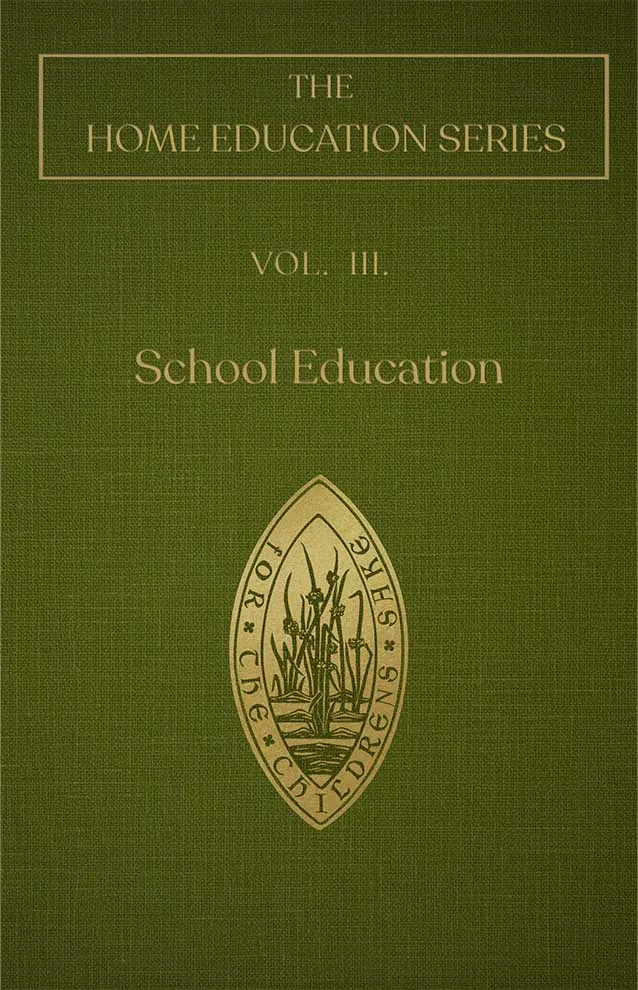
School Education
Charlotte Mason's School Education (Volume 3 of her Home Education Series) builds on the foundational principles from the earlier volumes by turning attention to the education of children roughly ages 9–12, offering practical guidance for developing a thoughtful curriculum suitable for home or school settings. Subtitled "Developing a Curriculum," the book asserts that children are born persons capable of forming their own vital connections with knowledge when presented with rich, living ideas rather than predigested facts or mechanical drills. Mason critiques prevailing educational theories of her time, emphasizing authority balanced with docility (willing obedience), the child's right to ample leisure, free play, and "masterly inactivity" from adults to allow natural growth. She advocates short, focused lessons to maintain attention, narration as a primary means of assimilation, and a broad, liberal curriculum that feeds the mind with ideas from living books, nature study, art, music, poetry, history, and Scripture—treating education as the science of relations where children build personal relationships with knowledge. The volume explores how education should respect children's personhood by avoiding excessive interference, promoting habits of attention and self-education, and fostering a love of knowledge through inspiring sources rather than busywork or examinations. Mason stresses the importance of outdoor life, nature observation as the foundation of science, hands-on mathematics, and moral training through literature and example. By providing children with a generous feast of ideas across subjects, allowing time for reflection and narration to process them, and cultivating reverence for God and the true, good, and beautiful, the method aims to produce well-rounded individuals with strong intellects, sound characters, and a lifelong appetite for learning. This work bridges the early childhood focus of Home Education and the parental roles in Parents and Children, laying groundwork for the more advanced applications in later volumes.
- Introduction1:38
- Preface4:09
- Docility and Authority in the Home and the School: Part 122:08
- Docility and Authority in the Home and the School: Part 222:22
- Masterly Inactivity20:25
- Some of the Rights of Children as Persons14:57
- Psychology in Relation to Current Thought23:09
- Some Educational Theories Examined22:30
- An Adequate Theory of Education21:16
- Certain Relations Proper to a Child22:37
- A Great Educationalist17:35
- Some Unconsidered Aspects of Physical Training21:59
- Some Unconsidered Aspects of Intellectual Training25:07
- Some Unconsidered Aspects of Moral Training20:07
- Some Unconsidered Aspects of Religious Education19:46
- A Master-Thought30:49
- School-books and How they Make for Education17:59
- How to Use School-books15:45
- Education, The Science of Relations: We are Educated By Our Intimacies: The Prelude And Præterita20:54
- We are Educated By Our Intimacies: Part 2 — Further Affinities18:24
- We are Educated By Our Intimacies: Part 3 — Vocation23:51
- Suggestions Towards a Curriculum - For Children Under Fourteen - Part 124:14
- Suggestions Towards a Curriculum - For Children Under Twelve - Part 2: School-books22:29
- Suggestions Towards a Curriculum - Part 3 - The Love of Knowledge15:52
- Paideia Closing0:33
Chapter-by-chapter navigation, listening progress, and bookmarks are available in the member library.
Next in the Series
Ourselves
Charlotte Mason's Ourselves (Volume 4 of her Home Education Series), subtitled Ourselves, Our Souls and Bodies, stands apart from the…
Audiobook · 1904
Formations of Character
Charlotte Mason's Formation of Character (Volume 5 of her Home Education Series), originally titled Some Studies in the Formation of…
From Our Essays
Charlotte Mason — A Gentle, Timeless Philosophy
An introduction to Charlotte Mason — the life and ideas behind this book.