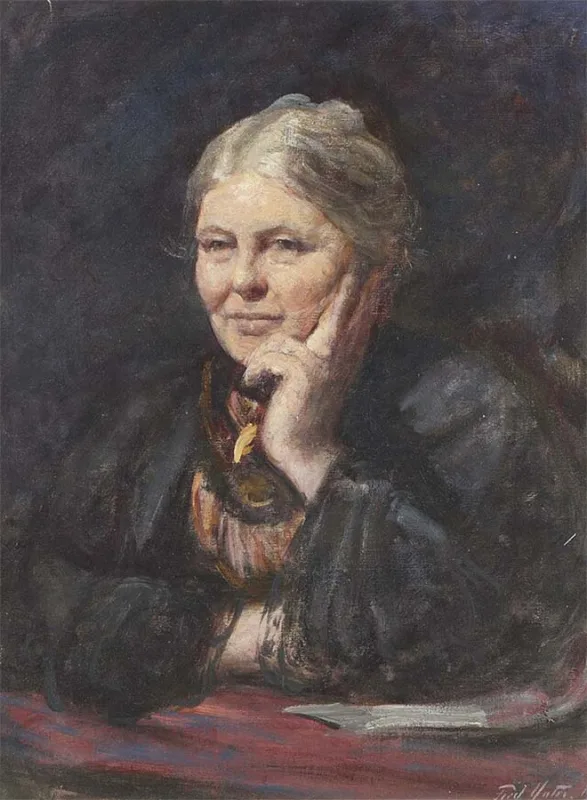
Charlotte Mason
The educator who insisted that children are born persons — and built a whole philosophy of teaching on that single conviction.
All six volumes are in the CollectionWho was Charlotte Mason?
Charlotte Mason (1842–1923) was a British educator and philosopher whose ideas on childhood learning still shape home education worldwide. Born in Wales and largely taught at home, she trained as a teacher in London and worked in British schools before her experience of conventional Victorian schooling prompted something different: a philosophy that treated children as born persons — full individuals with inherent dignity, curiosity and moral potential — rather than empty vessels to be filled.
In the mid-1880s she delivered a series of Lectures to Ladies in Bradford that became the foundation of her life's work. She went on to found the Parents' National Educational Union in 1887, the House of Education teacher training college at Ambleside in 1892, and the Parents' Review journal. Her thinking is set out across the six volumes of the Home Education Series, written over four decades.
“Education is an atmosphere, a discipline, a life.” A Philosophy of Education
The ordinary conditions of a child's home and surroundings — about a third of an education, she reckoned, and none of it formally taught.
The deliberate forming of good habits — of attention, of truthfulness, of work — rails laid down so that a child's days run smoothly instead of jolting over rough ground.
The mind living upon ideas, the way the body lives upon food — a living idea being something a child can take in, turn over, and grow by.
Mason compressed her whole method into one sentence, and then spent six volumes unfolding it.
Every volume below is an audiobook in the Collection.
Six volumes · 65 hours 34 minutes · included with membership
$15 a month · $149 a year · cancel anytime
The Home Education Series
The foundation — delivered first as lectures to parents, and aimed at the education of children under nine.
Turns from the child to the parents themselves — their responsibilities, and what Mason called their high calling.
The curriculum years, roughly ages nine to twelve — practical guidance for home or school.
Written to young people themselves, not to their teachers — an allegory of the soul and its powers.
How character is actually shaped — through habit, wise discipline, and the influence of living ideas.
The culmination — subtitled A Liberal Education for All, and the most complete statement of her thought.
Where should I start?
The six volumes do not have to be taken in order. Most people arrive looking for one of these three things.
The education of children under nine — outdoor life, habit, living books, and the work of the mother. Most families begin here, because it is where Mason begins.
Begin with Volume I →Her last book, written after forty years of practice — the clearest statement of the method, including the twenty principles. The one to read if your children are already older.
Begin with Volume VI →Addressed to the students themselves — Book I for younger readers, Book II for those older. A course in self-knowledge a family can take together.
Begin with Volume IV →If you don't know where to start, start with Volume VI. It is Mason's summary of her philosophy, providing a foundation — once those ideas are familiar, the other five works allow you to dig deeper into each idea.
Questions people ask
The things most often searched about Mason, answered plainly.
What does “children are born persons” mean?
It is Mason's first principle, and everything else follows from it. A child is not a blank slate to be written on, nor a vessel to be filled, nor raw material to be molded — but already a whole person, with their own mind, dignity, curiosity and moral life. The adult's task is to feed that mind, not to manufacture it.
What is the Charlotte Mason method?
In her own formula, education is an atmosphere, a discipline and a life: the surroundings a child grows up in, the habits deliberately formed in them, and the living ideas they are given. In practice it means living books rather than textbook summaries, narration instead of testing, short focused lessons, and a generous curriculum of literature, history, nature and art.
What are the six volumes of the Home Education Series?
Home Education, Parents and Children, School Education, Formations of Character, Ourselves and A Philosophy of Education. All six are in the Paideia Collection.
How long is the whole series?
Sixty-five hours and thirty-four minutes across the six volumes — from School Education at just under eight hours to Formations of Character at a little over thirteen.
Who was Charlotte Mason to the wider world?
She founded the Parents' National Educational Union in 1887, the House of Education teacher training college at Ambleside in 1892, and the Parents' Review. Her schools and correspondence curriculum carried the method well beyond Britain, and it remains one of the most widely followed approaches in home education today.
What is a living book?
Mason never gave a tidy definition. The difference is easier to hear.
Told by a textbook
A whole life, as it is usually set down
Alexander III of Macedon was born in 356 B.C. at Pella, the son of King Philip II and Olympias of Epirus. He was taught by the philosopher Aristotle from about the age of thirteen.
He became king at twenty. He invaded Asia Minor in 334 B.C. and defeated the Persians at the Granicus, at Issus, and at Gaugamela. He reached India in 326 B.C. He died at Babylon in 323 B.C. at the age of thirty-two.
He is important because he spread Greek culture across a large area.
Told by a living book
One moment of it — Jacob Abbott, History of Alexander the Great
…while all the other by-standers were joining in the general condemnation of the horse, Alexander stood quietly by, watching his motions, and attentively studying his character. He perceived that a part of the difficulty was caused by the agitations which the horse experienced in so strange and new a scene, and that he appeared, also, to be somewhat frightened by his own shadow…
Alexander turned his head in such a direction as to prevent his seeing his shadow. He quietly and gently laid off a sort of cloak which he wore, and sprang upon the horse's back. Then, instead of attempting to restrain him… he gave him the rein freely, and animated and encouraged him with his voice, so that the horse flew across the plains at the top of his speed, the king and the courtiers looking on, at first with fear and trembling, but soon afterward with feelings of the greatest admiration and pleasure.
…Philip commended him very highly: he told him that he deserved a larger kingdom than Macedon to govern.
A textbook tells you what to remember for the test. Abbott gives you a boy, a horse, a shadow, and a father who sees a kingdom too small. One is information. The other is an idea a child can picture.
It is the test we apply to everything we choose to record. See what is in the library →
Hear her in her own words
All six volumes of the Home Education Series, alongside a growing library of classic titles for the whole family.
The audiobooks of the complete Home Education Series have sold elsewhere for over $140. Here they are included in your membership, alongside everything else in the library.
$15 a month · $149 a year